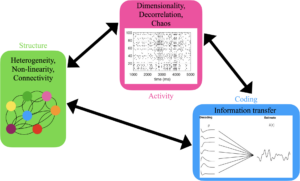
The brain is a unique system, in that its dynamics have a clear function: making its owner respond to the world around it. In order to perform this function, the brain continuously processes information. How do the dynamics of neurons and networks result in information processing? The physical structure of the brain (its ‘hardware’) shapes this information processing and vice versa: the computations needed for information processing (the ‘software’) are adapted to the physical structure of the hardware. In order to study these interactions, we adopt the following strategies to go from biological realism to overarching principles of network computation:
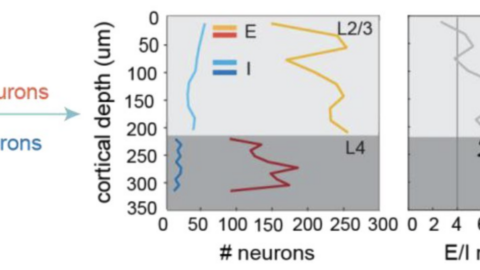
- We collaborate with colleagues that do experimental neuroscience. This way, we can measure properties like heterogeneity or connectivity in real brains. By doing this, we also develop new analysis methods or protocols.
- From the experimental data, we derive biophysically realistic models, both on a single neuron and on a network level.
- From the biophysically realistic models, we make abstract models to study how the neuron and network properties that were found in 1 and 2 influence network dynamics.
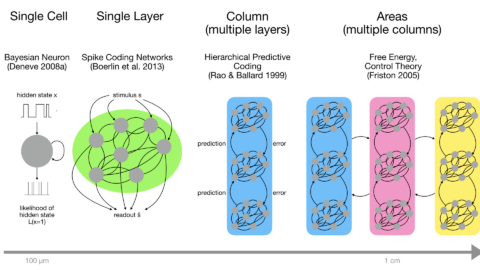
- To study how structural and dynamical properties of networks influence coding and task performance, we use different coding frameworks: reservoir computing, spike coding networks, and predictive coding.
This way, we aim to derive overarrching principles of how networks compute. This is relevant for the study of our brains, but also for neuromorphic computing and other system that are network-based, think about animal collectives or molecular networks (the aim of SmartNets). For each of these topics, see below for recent advances, papers, code and datasets.
For current open internship projects, see this page. Since we do mostly modelling, computer simulations and advanced data analysis (that means, bluntly said, computer programming and mathematics), some affinity and experience with math and programming would really help. For some resources, you can take a look here. If you’re motivated and willing to learn, you don’t have to be an expert of course, but especially for short internships it is better to be able to focus on the science than on learning how to program.